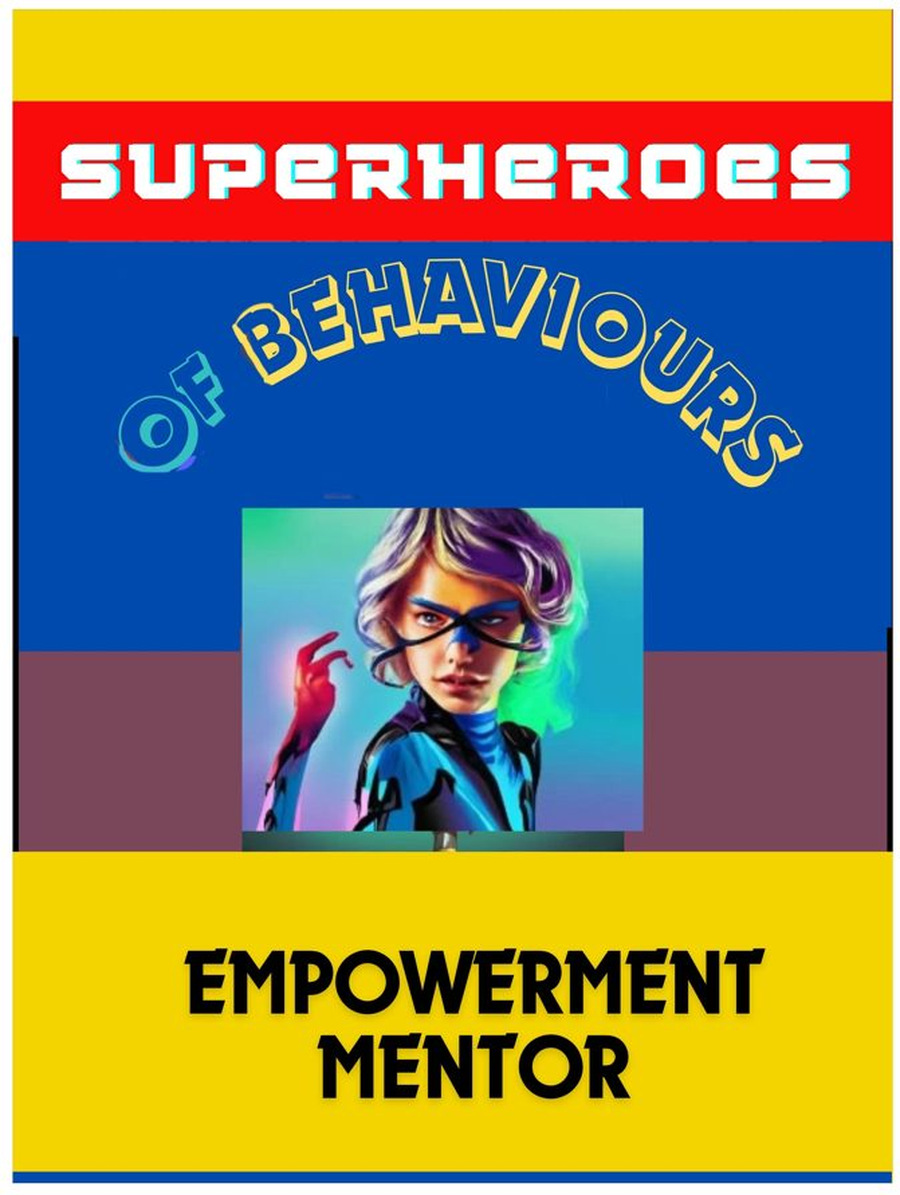
Sarah's Vision Board — Embrace Your Uniqueness
In a quiet forest clearing, bathed in the soft light of a setting sun, Sarah sat on a mossy log with her heart heavy. A Year 9 student, she had spent months feeling like she didn't measure up — too shy to speak in class, too unsure to share the artwork she secretly loved to make. She had come here hoping to meet someone people spoke about in whispers: The Empowerment Mentor.
The Mentor appeared, calm and warm, with eyes that seemed to understand her before she said a word. Slowly, Sarah began to share her fears and insecurities, and the Mentor simply listened, their presence like a comforting embrace. When she finished, the Mentor spoke gently. "You have a remarkable journey ahead of you, Sarah. But remember this: your uniqueness is your superpower. Stop trying to shrink into everyone else's shape. Embrace what makes you different, and you'll find the strength you've been searching for."
The words settled over Sarah like warmth after cold. She left the clearing feeling as though a heavy burden had lifted. Back home, she found an empty board and began to fill it — images of faraway places she dreamed of visiting, words that made her feel brave, and photographs of her own drawings. It was a vision board, a picture of the person she wanted to become and the life she wanted to build.
Each morning, Sarah glanced at that board before school, and each glance nudged her confidence a little higher. She started small. She raised her hand in class instead of staring at her desk. She entered one of her sketches in the school art display. Every brave step reminded her that her individuality wasn't something to hide — it was the very thing that made her work, and her voice, worth sharing.
Weeks later, Sarah faced a quieter test. Walking through the busy school hallway, she noticed a new student, Emily, sitting alone at a lunch table, looking lost and lonely. The first time she saw her, Sarah hesitated, consumed by her old insecurities, and walked past. But the memory of that moment nagged at her. She knew what it felt like to sit on the outside.
The next time she spotted Emily still alone, something inside her stirred. Remembering the Mentor's words about the strength her uniqueness gave her, Sarah walked over and struck up a conversation. As they talked, Emily's face lit up and the loneliness melted away. Sarah introduced her to her friends, and before long the two were inseparable.
As the weeks passed, classmates began coming to Sarah for advice and encouragement — she had become a source of strength for others, just as the Mentor had been for her. She had learned the Empowerment Mentor's greatest lesson: believing in yourself isn't about pretending to be someone else. It is about reclaiming your own worth, embracing what makes you different, and then using that strength to lift the people around you.
Your turn — short-answer questions
- The Mentor told Sarah that her "uniqueness is your superpower." How did believing this change the choices Sarah made at school?
- Sarah built a vision board to picture the person she wanted to become. Describe one personal strength you could grow this term, and one small step you could take toward it.
For the classroom
Teacher notes — activities, reflections and assessment for this story.
Discussion: What does it mean to say "your uniqueness is your superpower"? Ask students why Sarah's self-doubt held her back, and what finally helped her reclaim her confidence.
Activity — Vision Board: Students create their own vision board of dreams, goals and personal strengths, then explain to a partner how it reflects who they want to become.
Activity — Goal Setting: Have students set one realistic personal goal and map out the small, achievable steps needed to reach it.
Reflection: Sarah used her own growth to include someone who felt alone. Reflect on a time you noticed someone left out — what could you do to lift them up?
Assessment — Strength Journal: Students maintain a journal across the term recording their personal strengths, areas of growth, and moments they recognised their own progress.
Tyler and the Bench
Tyler had always defined himself by basketball. In Year 10 he was one of the first names on the team sheet — until a new coach arrived, the squad grew, and Tyler found himself on the bench, watching the games he used to star in. Week after week he sat in his warm-up top, barely getting on court, and a cold voice inside him whispered that if he wasn't the star player, he was nothing at all.
He stopped trying in training. He stopped enjoying the sport he loved. One evening, sitting alone in the empty gym long after the others had left, he heard footsteps. The Empowerment Mentor sat down beside him on the bench. "You've decided that your worth lives on a scoreboard," the Mentor said quietly. "But you are so much more than the minutes you play."
Tyler scoffed. "What's the point of me if I'm not scoring?" The Mentor smiled. "Your value was never only in points. Who lifts the team when they're flat? Who helps the younger players find their feet? Stop measuring yourself by one number, and you'll find a strength you forgot you had."
The words stayed with Tyler. The next training session, instead of sulking, he threw himself in — not to prove he deserved to start, but because he loved the game. He began encouraging the newer players and sharing the tricks he had learned over years. He turned up early, stayed late, and cheered loudest from the bench. Slowly, the joy came back, and with it something steadier than the old thrill of being the star: a sense of worth that didn't rise and fall with his stats.
His coach noticed. Tyler's attitude lifted the whole squad, and his game time gradually returned. But by then Tyler had learned that it was never really about the minutes. One afternoon he spotted a younger player, Sam, close to quitting after being dropped from the starting five, sitting exactly where Tyler had once sat. Tyler walked over. "I know how that feels," he said. "But you're worth more than a spot on a team sheet. Come on — I'll show you."
Sam stayed. And Tyler realised he had become for someone else what the Empowerment Mentor had been for him. He had learned the Mentor's greatest lesson: your worth isn't handed to you by a scoreboard, a ranking or anyone else's approval. It is yours to claim — and once you truly believe it, you can help others believe it too.
Your turn — short-answer questions
- Why did being dropped to the bench make Tyler feel worthless, and what changed the way he saw himself?
- The Mentor said Tyler's worth was "never only in points." Describe one way you sometimes measure your worth, and a healthier way to see yourself.
For the classroom
Teacher notes — activities, reflections and assessment for this story.
Discussion: Why is it risky to tie your whole self-worth to one thing — a sport, a grade or a label?
Activity — More Than One Number: Students list five different strengths or roles they bring to a group, beyond the obvious one they are known for.
Activity — Bench to Belief: In pairs, role-play encouraging someone who feels they have failed, practising words that rebuild self-worth.
Reflection: Think of a setback that made you doubt yourself. What strengths did you still have that the setback couldn't take away?
Nadia Asks for the Harder Room
Nadia was the best mathematician in her class, and it had quietly stopped meaning anything to her. She had been moved into Standard maths at the end of Year 9, during a term when her nan was ill and almost nothing got done, and she had stayed there ever since. She topped every test. Teachers wrote lovely things on her reports. Half the room borrowed her working before the bell. The problem was the course outline stuck to the fridge at home: the animal science pathway she had wanted since she was eleven required Advanced maths, and Advanced maths was a room Nadia had never once set foot in.
At the subject selection evening in August she sat beside her mum in the library while Mr Boyd went through her options with real warmth. "You're flying where you are," he said. "I'd hate to set you up to fail." Her mum nodded, relieved, because that sounded like kindness and mostly was. Nadia wrote Standard on the form in careful handwriting, and something inside her went very quiet. Walking to the car she caught herself thinking a sentence she had been thinking for two years without noticing: someone like me doesn't do Advanced. She had no idea when she had started believing it.
The Empowerment Mentor was waiting at the bus stop the next morning, hands in pockets, entirely unbothered by the rain. "You've let a timetable decide what you're made of," the Mentor said. Nadia said she had been put in Standard for a reason. "You were put there during the worst term of your life," the Mentor replied, "and then nobody went back and looked again, including you. So here's what you'll do. One sentence, three parts. What you want. What you know you're missing. What you'll do about it. You don't have to prove you belong before you ask — that's backwards. You ask, and then you do the work."
She practised it eleven times in the bathroom mirror before she said it to Ms Fadel, the head teacher of maths, on a Thursday morning with her heart going like a drum. "I want to move into Advanced. I know I've missed trigonometry and most of last year's algebra. I'll catch both up by the end of term if you give me a trial." Ms Fadel looked at her for a long moment and gave her four weeks. The first topic test came back with 61 written at the top, the lowest mark Nadia had ever received in her life, and she sat in the car park afterwards looking at it for a long time.
It got harder before it got easier. She understood perhaps half of what the class took for granted. Her old friends decided she thought she was better than them, and Rana asked whether she was too good for them now and only half meant it as a joke. For eleven days the transfer-back form sat folded in the bottom of her bag. The Mentor found her staring at it in the library. "A high mark in the wrong room isn't worth much," the Mentor said. "And being behind isn't the same as being less. You're not failing, Nadia. You're just no longer pretending that someone else's ceiling was yours."
So she used the ask again, this time on the missing pieces: two lunchtimes a week with Ms Fadel, and a straight request to the boy beside her to explain the working he did in his head. By the final exam she scored 74 — solidly mid-table, nowhere near the top, behind students who had been in that room since Year 9. She had traded certain praise for honest struggle, and the animal science pathway was still open. Nadia had learned the Empowerment Mentor's greatest lesson: your worth is not decided by the room somebody once put you in. It is yours to claim — and claiming it usually starts with one honest sentence asked out loud.
Your turn — short-answer questions
- Mr Boyd's advice was kind and Nadia's marks in Standard were excellent. Explain why staying there would have cost her more than moving, and what the Mentor meant by "someone else's ceiling".
- The one-sentence ask has three parts: what you want, what you know you're missing, and what you'll do about it. Write your own one-sentence ask for something you want but have talked yourself out of.
For the classroom
Teacher notes — activities, reflections and assessment for this story.
Discussion: Nadia had believed "someone like me doesn't do Advanced" for two years without noticing. Where do beliefs like that come from, and how would you spot one in yourself?
Activity — The One-Sentence Ask: Students draft and rehearse a three-part ask for a real goal, then deliver it to a partner who responds as the teacher, coach or employer would.
Activity — Comfortable or Growing: In pairs, students map an area where they are comfortably good and one where they would be a beginner, then discuss the honest costs and gains of each.
Reflection: Nadia swapped certain praise for honest struggle and a mid-table mark. Describe a time you chose the harder path, or one you are avoiding right now, and what it would cost you either way.
Story 3 is part of the full pack
Unlock every hero's third story — plus all worksheets, quizzes and assessments — with a trial or a licence. Already have access? Open the link from your email on this device.