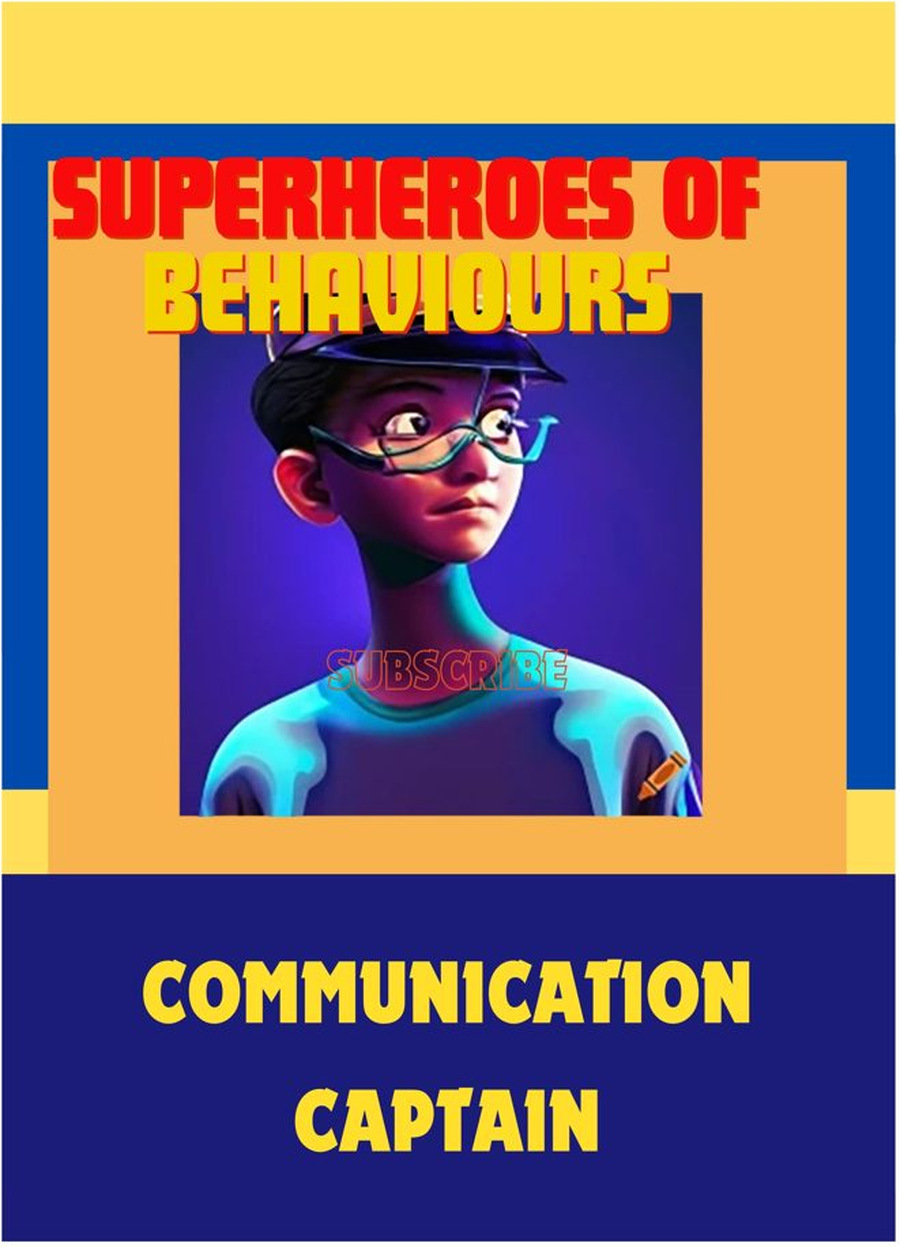
Sarah Finds the Words — Building Bridges, Not Barriers
Sarah and her best friend Mia had barely spoken in three days. It had started with a small thing — a message left on read, a plan that fell through — but the silence had grown into a cold wall neither of them knew how to climb over. Sarah replayed the argument in her head a hundred times, frustrated and confused. "I just wish Mia understood how I feel," she muttered to herself in the empty courtyard.
That was when The Communication Captain appeared, calm and steady. "Then let's talk it out," the Captain said. "Real connection starts with two things — truly listening, and expressing yourself clearly. Make your words a bridge, not a barrier." The Captain explained that most conflicts aren't about people being cruel; they're about messages getting tangled on the way from one heart to another.
The Captain taught Sarah to listen actively — to put down her phone, look Mia in the eye, and reflect back what she heard before defending herself. He showed her how to swap blaming "you always" statements for honest "I felt" ones. That afternoon, Sarah found the courage to message Mia. Instead of accusations, she wrote, "I've missed you, and I think we misunderstood each other. Can we talk?" Within an hour, the wall between them began to crumble.
A week later, Sarah's new skills were put to a harder test. In the busy school courtyard she came upon two friends, Alex and Jordan, locked in a heated argument, their voices rising with every word. "What's going on?" she asked. Both of them started talking over each other about a surprise party they were planning for their friend Chris. Sarah took a breath and simply listened, letting each of them finish.
As she listened, she realised the fight wasn't really about the party at all — it was about two people who each assumed they knew best and had never actually asked what Chris wanted. Gently, Sarah asked, "Have you thought about how Chris would like to celebrate?" The question stopped them mid-sentence. When they invited Chris for a chat, they discovered he had always wanted something small and low-key with close friends, not a big loud party.
With Sarah quietly mediating, Alex and Jordan reached a compromise: a surprise gathering at Chris's favourite park. Frowns turned to grins, and the courtyard that had felt like a battleground filled with laughter again. Sarah understood then what the Captain had meant — good communication wasn't about winning or talking the loudest. It was about listening deeply, speaking clearly, and caring enough to understand another person's side. From that day on, clear and compassionate words became her real superpower, and the friendships around her grew stronger for it.
Your turn — short-answer questions
- How did Sarah repair her friendship with Mia? Identify two communication skills she used and explain why they worked.
- When Alex and Jordan argued, Sarah asked a question instead of taking a side. Describe a disagreement you have seen, and one question that could have helped both people understand each other.
For the classroom
Teacher notes — activities, reflections and assessment for this story.
Discussion: Why is listening just as important as speaking in effective communication? Recall a time when unclear communication led to confusion or conflict.
Activity — Active Listening Practice: In pairs, take turns sharing a personal story while your partner listens without interrupting, then summarise what you heard as accurately as you can.
Activity — The Clarity Challenge: Give students ambiguous sentences and, in pairs, have them rewrite each one to be clear and concise, then discuss how vague wording causes misunderstandings.
Activity — Conflict Role-Play: In small groups, act out a conflict scenario like Alex and Jordan's and practise resolving it by listening, asking questions and finding common ground.
Assessment — Communication Growth Journal: Students keep a journal documenting real situations where they applied active listening, clear messaging or empathy, then write a final reflection on how their communication has improved.
Tom and the Team Huddle
Tom loved his Saturday soccer team, but this season something was off. Their new midfielder, Riley, kept holding the ball too long, and the team's attacks fell apart because of it. Tom could see it, and so could everyone else — during matches, players rolled their eyes and muttered under their breath. Riley noticed the frustration but not the reason, and each week he tried harder and played worse.
Tom wanted to say something, but every version he rehearsed sounded harsh. "Stop hogging the ball" would only start a fight. So he stayed silent, and the tension grew. After a heavy loss, he found The Communication Captain waiting by the changing rooms. "You've got something to say to Riley," the Captain observed. "But you're afraid the words will land like a punch."
Tom nodded. The Captain smiled. "Then don't throw a punch — build a bridge. Speak about what you see, not who he is. Use 'I' and 'we', not 'you always'. And say it to help him, not to blame him." Together they shaped the message until it felt honest instead of harsh.
On Tuesday, Tom pulled Riley aside before training — not in front of the whole squad, but quietly, one to one. "Hey, I wanted to chat about the game," he began. "When we pass early, I reckon we're a way better team, and I think you'd get more goals set up for you too. Want to try a few quick one-touch drills together?" Riley's shoulders, braced for an attack, slowly relaxed. "I didn't even realise I was slowing us down," he admitted. "I thought everyone was just annoyed at me."
That single honest conversation changed the season. Riley started releasing the ball earlier, the attacks flowed, and the muttering on the sidelines faded. More than that, Riley began to trust Tom, and the two became a partnership on the pitch. When another teammate later had a problem, it was Riley who said, "Just talk to them properly — it's how Tom sorted things out with me."
Tom realised the Captain had been right all along. The problem had never been that the feedback was too hard to hear; it was that no one had said it in a way that could be heard. Clear, kind, well-timed words did what months of eye-rolling never could. Speaking up, he learned, isn't about being blunt or being nice — it's about being understood.
Your turn — short-answer questions
- Why did Tom's eye-rolling and silence make the situation worse, and what made his eventual conversation work?
- Tom spoke to Riley privately and used "I" and "we" statements. Describe a time you had to give someone difficult feedback — how could you word it to build a bridge rather than a barrier?
For the classroom
Teacher notes — activities, reflections and assessment for this story.
Discussion: Why can the same message land completely differently depending on how, when and where it is said?
Activity — Rewrite the Blame: Give students "you always" statements and have them rewrite each as an "I" or "we" statement that is easier to hear.
Activity — Time and Place: In pairs, discuss which settings make hard conversations easier or harder, and why Tom chose a private, one-to-one moment.
Reflection: Recall a time feedback was given to you badly. How could the person have said it so you could actually take it on board?
Ibrahim and the Money That Went Missing
Ibrahim was the one who made things happen. In Year 9 at Bellhaven High he ran the fundraising committee's Harmony Day stall like a small business — rosters on a shared spreadsheet, drinks ordered a fortnight early, a sign-up sheet for clean-up that people actually signed. The stall raised eleven hundred dollars for the local refuge, the best result the school had seen, and Mr Deng announced that Ibrahim would be reading the cheque presentation at assembly. His mum kept a photo of the stall on the fridge. For the first time, Ibrahim felt like someone the school counted on rather than just another loud kid in the back row.
Then the money didn't balance. On the Monday, the tin was a hundred and eighty dollars short, and Ibrahim knew exactly why. He had carried the takings home on Friday to count them, slid the notes into an envelope, pushed the envelope into the side pocket of his school bag — and it wasn't there any more. He had turned his room upside down twice. But when Mr Deng frowned at the tally sheet, everyone's eyes went to Grace, the quiet Year 8 who had minded the tin for the last hour of the stall. By Wednesday there was a group chat none of the teachers could see, and Grace was eating lunch behind the library on her own. Ibrahim said nothing for four days.
He was staring at the assembly script when The Communication Captain sat down on the desk beside him. "You know what needs saying," the Captain said, "and you've worked out that every hour you wait makes it more expensive." Ibrahim's throat tightened. "If I say it now, everyone will think I stole it." The Captain shook his head slowly. "Some will, for a while. But silence is a message too, and right now yours is being read as *Grace did it*. Say it early, say it plain, and say it to everyone who heard the wrong version — not just to the person it's easiest to tell." Then he taught Ibrahim the shape of a real repair, in three parts.
The first part was what you did, with no story wrapped around it. The second was what it cost the other person, said in their words rather than yours. The third was what happens next — something specific enough that people could check it. "And take the 'but' out," the Captain added. "The moment you say *but*, everything before it disappears, and what people hear is a defence." Ibrahim wrote it out on the back of the assembly script, crossed out *I was really busy* and *it was an honest mistake*, and read the plain version until his hands stopped shaking. It was four sentences long, and every one of them cost him something.
He said it at the Thursday meeting, with the whole committee there. "I took the tin home on Friday and lost a hundred and eighty dollars of it. I stayed quiet for four days while everyone said it was Grace, and she's been eating lunch on her own because of me. I'm paying it back out of my bakery shifts by the end of the month, and I'm posting the same thing in the year group chat tonight." Nobody clapped. Mr Deng gave the cheque presentation to someone else. Two mates were cold with him for a fortnight. When he found Grace at her locker and said it again to her face, she just looked at him and said, "Okay." That was all. It took her most of the term to sit near him again.
The refuge got its eleven hundred dollars, six Saturday shifts of it out of Ibrahim's own pay. He never got the assembly, and he wasn't picked as committee lead the following year. But something else happened that he hadn't expected: when a rumour started about a Year 7 boy the next term, it was Grace who said, out loud, "Has anyone actually asked him?" — and it was Ibrahim she looked at when she said it. He had learned what the Captain meant all along. Clear words spoken early do what silence never can. Speaking up isn't about protecting how you look, and it isn't about being blunt — it's about saying the true thing in a way the other person can carry.
Your turn — short-answer questions
- The Captain told Ibrahim that "silence is a message too." What was Ibrahim's silence saying to the rest of the year group, and why did waiting four days make the repair harder?
- Ibrahim's repair had three parts: what he did, what it cost the other person, and what he would do next. Think of something you owe someone an apology for and write those three sentences — then explain what your version would sound like if you left a "but" in it.
For the classroom
Teacher notes — activities, reflections and assessment for this story.
Discussion: Why do apologies that include the word "but" so often make things worse? Compare "I'm sorry I was late, but the bus was delayed" with a version that names the cost to the other person.
Activity — The Three-Part Repair: Give students six weak apologies and have them rewrite each one as what I did / what it cost you / what I'll do next, then read both versions aloud and vote on which they would rather receive.
Activity — Say It to the Room: In small groups, students role-play correcting a rumour in front of the people who believed it, practising a calm opening line and how to respond if someone reacts badly.
Reflection: Ibrahim told the truth knowing it would cost him the assembly and the leadership role. What would make it hard for you to speak up in his position, and what would help you do it anyway?
Story 3 is part of the full pack
Unlock every hero's third story — plus all worksheets, quizzes and assessments — with a trial or a licence. Already have access? Open the link from your email on this device.