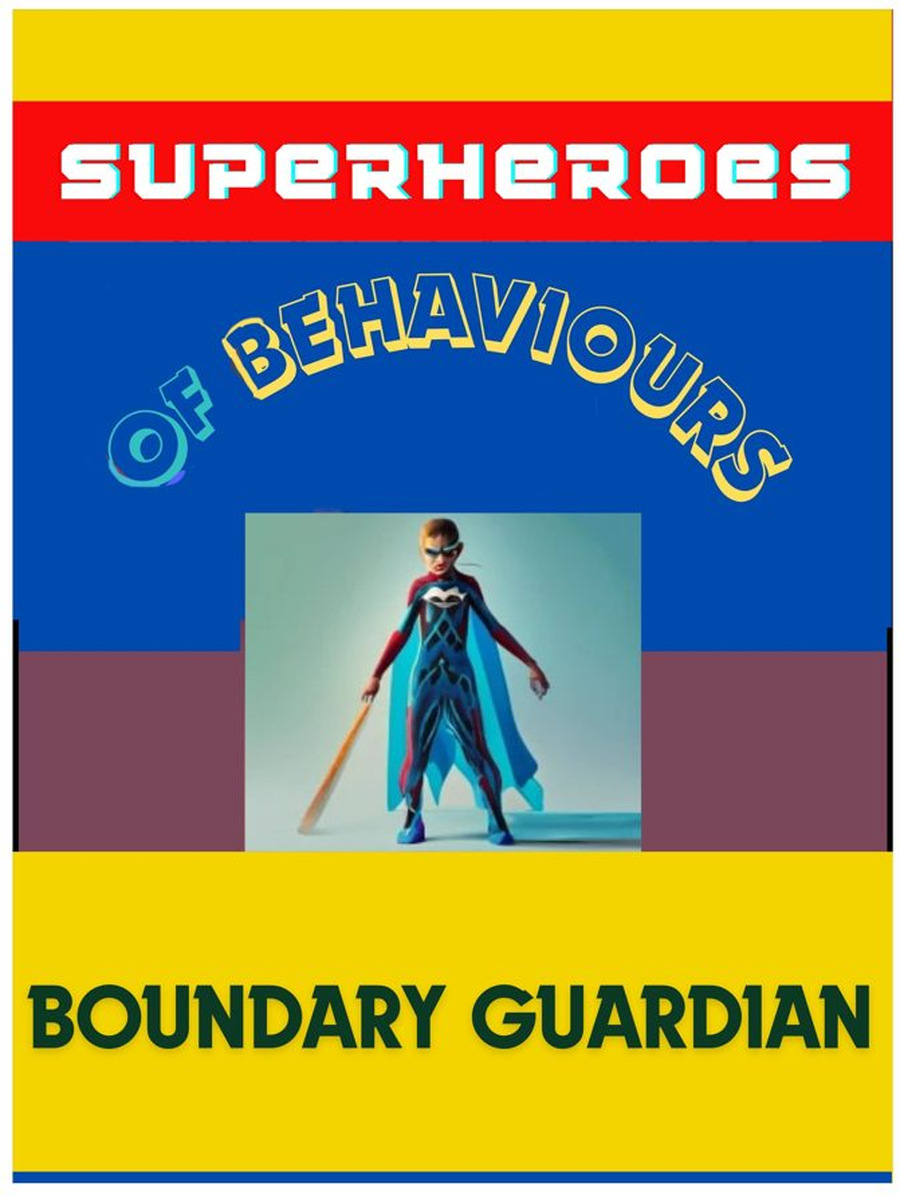
Jake's Empty Cup — Learning to Say No
Jake lived for the skate park. A Year 9 student with a tight-knit group of mates, he spent every afternoon grinding rails and every evening being pulled from one plan to the next. Someone always wanted him somewhere, and Jake — who hated the thought of letting anyone down — always said yes. A group chat that never went quiet, late nights at a friend's place, a favour here, a ride there. It was fun, at first.
But the yeses started to pile up. Jake was tired all the time. The board that used to feel weightless under his feet now felt like a chore, and his once-easy landings turned sloppy. His grades slipped as unfinished homework followed him from class to class. One Friday afternoon, drained and stressed, he sat alone on the edge of the skate bowl, watching his friends without the energy to join in.
That was when a calm figure sat down beside him — The Boundaries Guardian, a hero who helped teenagers find their balance. "I couldn't help noticing you've been juggling a lot lately," the Guardian said. Jake sighed. "My friends expect me everywhere, all the time. I don't want them to be mad at me."
The Guardian nodded gently. "Being a good friend matters. But you can't pour from an empty cup. Setting a boundary isn't shutting people out — it's telling them honestly what you need. A healthy no protects your yes." Then they offered Jake a simple challenge: pick one thing this week that mattered most, and say a kind but clear no to the rest.
It felt terrifying. The next day, when the group chat lit up with plans, Jake typed the hardest message he had ever sent: "Can't tonight — I need to catch up on sleep and homework. Skate tomorrow?" His thumb hovered before he hit send. A couple of friends seemed surprised, and one teased him, but the world did not end.
Over the following weeks, Jake practised. He said no to the late nights he couldn't afford and yes to rest, to study, and to the sessions he genuinely wanted. Slowly, his energy came back. His landings sharpened again, his grades climbed, and the passion he thought he had lost returned. Even his friends noticed the change — and when they saw how much better he seemed, they began respecting his limits, and thinking harder about their own.
Months later, Jake still loved the skate park just as much. The difference was that he moved through his life on his own terms now. He had learned the Boundaries Guardian's greatest lesson: setting healthy boundaries isn't selfish, and it isn't about pushing people away. It is an act of self-respect — the thing that lets you show up, rested and whole, for the people and the passions that matter most.
Your turn — short-answer questions
- What warning signs told Jake that his commitments were taking a toll on him, and why did he keep saying yes anyway?
- The Boundaries Guardian says "a healthy no protects your yes." Describe one boundary you could set in your own life this week — and explain what makes it hard to say.
For the classroom
Teacher notes — activities, reflections and assessment for this story.
Discussion: What does "you can't pour from an empty cup" mean? Ask students to share consequences they have seen when someone neglects their own well-being to please others.
Activity — Saying No With Respect: In pairs, role-play a scenario similar to Jake's. Take turns being the person who must set a boundary and the friend who pushes back, practising a clear but kind "no."
Activity — My Boundaries Map: Students list their key commitments (school, sport, friends, family, rest) and mark which ones drain them and which ones fill them up, then identify one boundary to set.
Reflection: Have you ever experienced the consequences of not setting healthy boundaries? How can setting boundaries positively affect your relationships and mental well-being?
Assessment — Self-Respect Journal: Keep a journal across a fortnight recording each time you set a boundary, how it felt, and how others responded, then write a final reflection on what changed.
Noor and the Never-Ending Favours
Noor was the girl everyone could count on. In Year 8 at Riverton College, if a classmate forgot their homework, Noor lent hers. If a group project needed someone to pull it together the night before, Noor stayed up late and did it. She liked being helpful — it felt good to be needed — but lately being needed had started to feel like being used.
It came to a head during a science assignment. Her group of four had split the work evenly, or so they promised. But as the deadline crept closer, one by one her groupmates went quiet. "You're so good at this," they said. "You'll fix it, right?" By Thursday night Noor was hunched over her laptop at 1am, doing three people's share, her own maths homework untouched and her eyes stinging.
The Boundaries Guardian found her the next morning, slumped at her locker. "You look like someone carrying four backpacks," the Guardian said kindly. Noor gave a tired laugh. "I don't want to be the person who lets the team down." The Guardian nodded. "Helping people is a gift. But when you say yes to everything, you say no to yourself. A boundary isn't a wall — it's a door you get to open on your own terms."
Together they practised the words. Not a cruel no, not an angry one — a clear, calm one. That afternoon, when her group asked her to redo the whole presentation again, Noor took a breath and said, "I've finished my part, and I'm happy to help for twenty minutes after school. But I can't do everyone's section for them." Her heart pounded as she waited for the fallout.
To her surprise, the group didn't fall apart. One member looked embarrassed and offered to finish his own slides. Another admitted she hadn't realised how much Noor had been carrying. The work got shared out — properly, this time — and the presentation still came together.
Over the following weeks, Noor kept practising. She still helped people, because that was who she was. The difference was that now she chose when, and how much. Her marks in her own subjects climbed, her late nights shrank, and she noticed something surprising: people didn't like her less for having limits. If anything, they respected her more. Noor had learned the Boundaries Guardian's lesson — being generous only works when you don't give yourself away in the process.
Your turn — short-answer questions
- Why did Noor keep saying yes to her group, even when it left her exhausted, and what finally changed her mind?
- Noor set a boundary by offering help "on her own terms." Describe a situation where you could offer help without taking on more than your fair share.
For the classroom
Teacher notes — activities, reflections and assessment for this story.
Discussion: Noor felt that saying no would "let the team down." Where does that pressure come from, and is it always true?
Activity — Fair Share Agreement: In groups, plan a project and write a simple agreement listing who does what, so the load is shared before the work begins.
Activity — The Kind No: Practise three different ways to say no that are clear but respectful, then rank which feel most natural to use.
Reflection: Think of a time you helped someone so much it cost you. What boundary could have protected your own needs?
Zara and the Midnight Messages
Zara had always been the one people came to. In Year 10 at Wattle Grove High she was the calm one — the friend who remembered birthdays and noticed when someone went quiet at the lunch table. So when her best mate Bridie's parents separated halfway through term two, Zara did what came naturally. "Message me whenever," she said. "Day or night. I mean it." At first it felt good, even important. Bridie needed her, and Zara was proud to be trusted with something so heavy. The messages came in the evening, then later, then later again, until Zara was falling asleep with her phone face-down on her chest, waiting for the buzz.
By the middle of term the buzz was coming at one and two in the morning, and Zara answered every single one. She wrote long, careful replies in the dark and then dragged herself through school on four hours' sleep — snapping at her little brother, handing in half-finished work, quitting hockey because she was too tired to run. What frightened her most was the new feeling in her stomach whenever the screen lit up: a small, guilty flinch. She loved Bridie. She had started to dread her. And underneath it all sat a thought she could not say out loud — what if I miss one, and something awful happens?
She was face-down on a library desk at lunch when someone sat quietly opposite her. "You're carrying somebody else's storm," said The Boundaries Guardian, "and you're doing it alone, in the dark, with nobody holding the other end." Zara didn't lift her head. "If I don't answer, who will?" The Guardian's voice stayed gentle. "That question is the trap. You're not the only person in the world who could help — you're just the only one who's been asked. A boundary isn't abandoning your friend. It's telling the truth about what you can carry, and making sure the rest gets carried by someone stronger." Then they taught her a sentence in three parts: care, limit, bridge.
Care meant saying the true thing first — *I love you and I'm not going anywhere*. Limit meant naming the edge honestly — *I can't do 2am any more; my phone goes off at ten*. Bridge meant never leaving somebody standing at that edge on their own — *I think you need someone bigger than me. Can I walk you to Ms Whelan's office on Monday, and sit outside while you go in?* Zara practised the three parts in the mirror until her voice stopped wobbling, then said them out loud on a cold Thursday, on the bench near the oval. She got all the way through. Bridie looked at the grass for a long moment, said, "So you're done with me," picked up her bag and walked off.
That was the cost, and it was real. Bridie didn't speak to her for a fortnight. Zara replayed the conversation every night, certain she had been selfish, twice deleting a message that would have taken it all back. "Boundaries can look like losing someone," the Guardian said, finding her at the bus bay one grey afternoon, "and for a little while, sometimes they are. But you didn't drop your friend. You handed her to bigger hands than yours." Three weeks later Bridie sat down beside her at lunch, unwrapped half a sandwich and pushed it across. She had been seeing Ms Whelan. Ms Whelan had rung her mum. "I was so angry with you," Bridie said. "You were the only one who didn't just tell me what I wanted to hear."
Zara slept properly that term for the first time in months. She went back to hockey, caught up her assessments, and kept being the friend who noticed things — only now she noticed herself as well. She still answered Bridie's messages; she just answered them in daylight, as a mate rather than a lifeline. Zara had learned the Boundaries Guardian's hardest lesson: setting healthy boundaries isn't a way of caring less, and it isn't a door slammed in someone's face. It is an act of self-respect — the honest limit that keeps you standing, so the people you love get a friend who is still whole enough to stay.
Your turn — short-answer questions
- Zara believed that if she stopped answering at 2am she would be letting Bridie down. What did the Boundaries Guardian say was wrong with that belief, and how did the "bridge" part of the sentence answer Zara's fear?
- Think of a situation where someone leans on you more than you can manage. Write out your own three-part boundary — care, limit, bridge — and explain which of the three parts would be hardest for you to say, and why.
For the classroom
Teacher notes — activities, reflections and assessment for this story.
Discussion: Zara felt responsible for something far bigger than a fifteen-year-old should carry. Discuss the difference between supporting a friend and being responsible for them, and who at school is the right "bigger set of hands."
Activity — Care, Limit, Bridge: In pairs, students take three sample scenarios (a friend who copies homework, a friend who messages all night, a friend who never lets you off the phone) and write the three-part sentence for each, then read them aloud until the wording sounds natural rather than harsh.
Activity — Who Else Can Help: Students map the trusted adults and services available to them (year adviser, school counsellor, family, Kids Helpline) and practise the single sentence they would use to hand a problem on to one of them.
Reflection: Zara's boundary cost her a fortnight of silence before things improved. Describe a time doing the right thing cost you something in the short term — what helped you hold your ground while you waited?
Story 3 is part of the full pack
Unlock every hero's third story — plus all worksheets, quizzes and assessments — with a trial or a licence. Already have access? Open the link from your email on this device.